

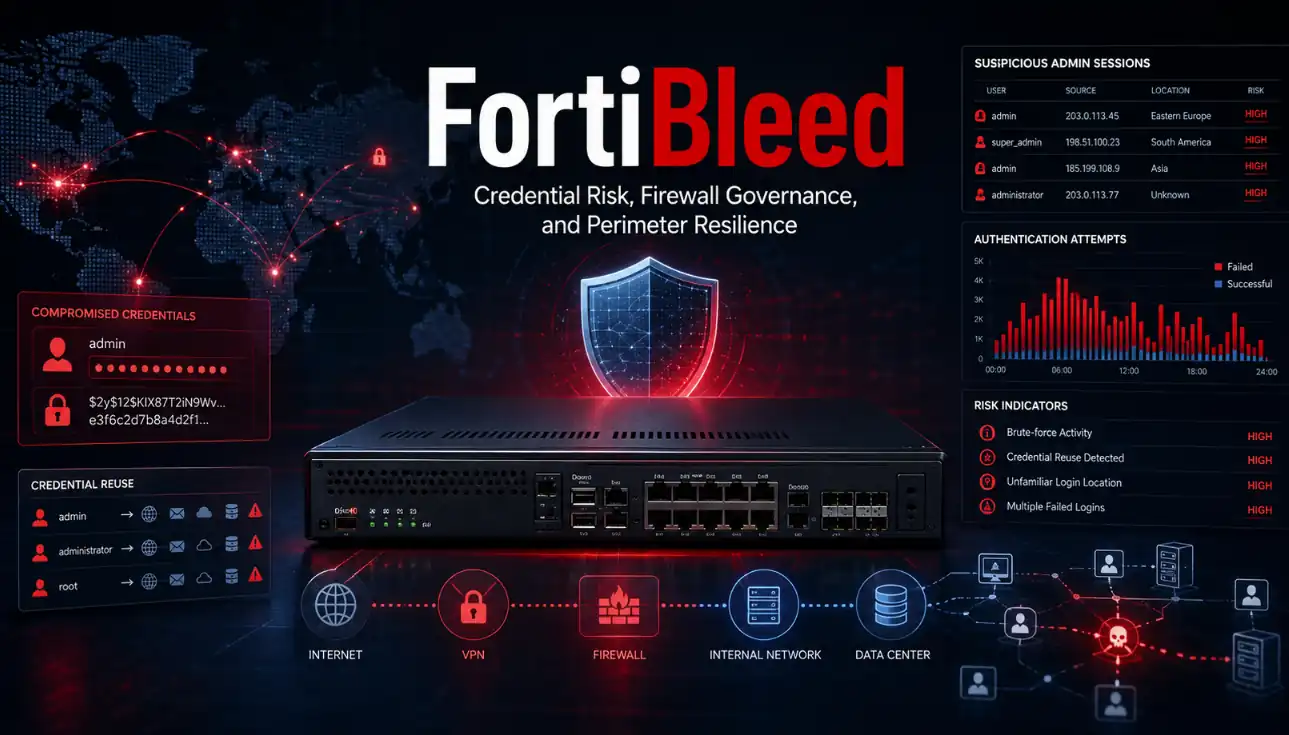
The reports around “FortiBleed” should not be interpreted simply as another technical alert affecting perimeter devices. For a CISO, the real lesson is broader and more strategic: firewalls, VPN gateways, and security appliances are no longer passive infrastructure components. They are privileged identity systems, remote access gateways, configuration repositories, and potential starting points for lateral movement. When credentials for such systems are exposed, reused, guessed, or harvested, the impact can quickly extend far beyond the device itself.
According to Fortinet’s own situational analysis, the currently reported activity does not represent a newly disclosed Fortinet vulnerability. Instead, Fortinet describes the campaign as a credential-harvesting and credential-reuse scenario, involving credentials from previous incidents and brute-force techniques against devices with weak password hygiene and no multi-factor authentication. This distinction is important. If the root cause is not a new zero-day but the reuse of old credentials, weak administrative practices, missing MFA, or incomplete remediation of previous advisories, then the issue becomes a governance failure as much as a technical one.
For CISOs, this is precisely where the conversation must start. The question is not only whether a FortiGate device is patched. The question is whether the organization has full control over its firewall identity lifecycle. Are all administrator and VPN accounts known? Are legacy accounts still active? Are shared accounts still used? Are privileged credentials rotated after relevant advisories? Is MFA enforced for every administrative and VPN login? Are management interfaces exposed to the internet? Are configuration changes reviewed against a known-good baseline?
Fortinet’s recommended immediate actions are direct and operational: terminate all active administrative and VPN sessions, reset Fortinet VPN and administrative passwords, enforce strong password policies, implement MFA for administrator and VPN users, upgrade to supported FortiOS versions, validate configurations, check logs, and reduce the attack surface by locking down management access. These are not optional best practices. In a credential-focused campaign, they are emergency containment measures.
The first priority is session control. If credentials may have been compromised, simply changing passwords is not enough while active sessions remain alive. Existing administrative and VPN sessions must be terminated so that any unauthorized access based on old credentials is invalidated. Only after that does credential rotation become effective. Password resets should cover all administrative users, all VPN users, and especially accounts on internet-facing systems. Particular attention should be given to generic, legacy, support-like, or default-looking accounts.
The second priority is MFA. In 2026, administrative access to internet-facing security infrastructure without MFA is no longer defensible. A firewall administrator account without MFA is not merely a weak control; it is a high-value attack path. The same applies to VPN users. If an attacker obtains or guesses a password, MFA may be the last barrier between credential exposure and full remote access. For privileged access, organizations should move beyond basic MFA where possible and consider phishing-resistant methods such as FIDO2, certificate-based authentication, or conditional access models.
The third priority is configuration integrity. Fortinet advises customers to review firewall and VPN users and other configuration elements for unauthorized changes, preferably by comparing them to a known-good configuration. This is a critical point. Attackers who gain administrative access to a firewall may not immediately trigger visible disruption. Instead, they may create new accounts, modify VPN settings, change routing, weaken policies, add trusted hosts, or prepare persistence mechanisms. A firewall can be compromised without appearing “down.” Therefore, configuration review must be treated as a forensic and governance activity, not as routine administration.
Organizations should look carefully for unrecognized accounts, including names that resemble legitimate vendor, support, cloud, or technical-service accounts. Account names such as “forticloud,” “fortiuser,” “fortinet-support,” or similar patterns should not be trusted simply because they sound plausible. Every account must have an owner, a business justification, an approved access level, and a documented lifecycle.
The fourth priority is log analysis. Fortinet recommends checking for unexpected administrator access from unknown IP addresses, reviewing domain controller logs for lateral movement, and investigating unusual access, suspicious accounts, and unauthorized configuration changes. This is where the CISO must ensure that the firewall is not treated as an isolated device. If the FortiGate appliance is integrated with Active Directory, LDAP, RADIUS, SAML, or other identity systems, a firewall compromise can become an identity compromise. The investigation must therefore include authentication infrastructure, VPN logs, endpoint telemetry, domain controllers, and SIEM correlation.
If there is any evidence of unapproved configuration modification or indicators of compromise, the device should be treated as compromised. This means moving from preventive hardening to incident response. The organization should check for the creation of VPN users, unexpected password resets, VPN logins from unusual geographies, and signs that attackers attempted to move from the perimeter into the internal network. If AD or LDAP integration is configured, the service account used by the firewall must also be treated with suspicion. It may have been exposed, abused, or used elsewhere.
The fifth priority is attack surface reduction. Fortinet’s recommendation is clear: restrict external management through trusted hosts, local-in policies, or remove internet administration altogether. From a CISO perspective, the best control is to avoid exposing administrative interfaces to the public internet in the first place. Administrative access should be limited to trusted networks, management jump hosts, privileged access workstations, VPN with strong MFA, or dedicated management channels. Internet-facing management should be the exception, not the default.
This case also highlights the importance of remediation governance. Fortinet notes that customers were provided guidance at the time of earlier advisories and are encouraged to ensure that remediation steps have been completed. This sentence is highly relevant for CISOs. Many organizations patch vulnerabilities but fail to complete the full remediation chain. They upgrade firmware but do not rotate credentials. They close one exposure but leave old accounts active. They implement MFA for employees but not for administrators or external support accounts. They document an exception but never review it again.
A mature response requires evidence. The CISO should not ask only, “Was the device patched?” The better questions are: “Which FortiGate devices do we operate? Which versions are they running? Which accounts exist on each device? Which accounts have admin rights? Which accounts are used for VPN access? Is MFA enforced everywhere? Are management interfaces exposed? When were passwords last rotated? Do we have a clean baseline configuration? Are logs forwarded to the SIEM? Have we checked for suspicious administrative access?”
This is also a board-level and audit-level topic. FortiBleed demonstrates that cybersecurity risk often persists in the gap between technical advisories and operational completion. The organization may believe that a risk was handled because an advisory was distributed or a patch was installed. But if credentials remain unchanged, sessions remain active, MFA is missing, or exposed management interfaces remain reachable, the residual risk remains high.
For CISOs, the key message is that perimeter security devices must be governed like critical privileged assets. They require inventory, ownership, configuration baselines, privileged access management, MFA, logging, review cycles, and incident response procedures. Firewalls are not only network controls; they are administrative control planes. Whoever controls them may control access into the enterprise.
FortiBleed should therefore be used as a trigger for a focused security review. The immediate actions are clear: terminate sessions, rotate credentials, enforce MFA, upgrade FortiOS, validate configurations, review logs, and remove public management exposure. The strategic action is even more important: establish a sustainable governance model for firewall administration and VPN identity management.
In modern cybersecurity, attackers do not always need a new vulnerability. Sometimes they only need an old password, an exposed admin portal, a forgotten account, or an incomplete remediation. That is the real CISO lesson from FortiBleed.