

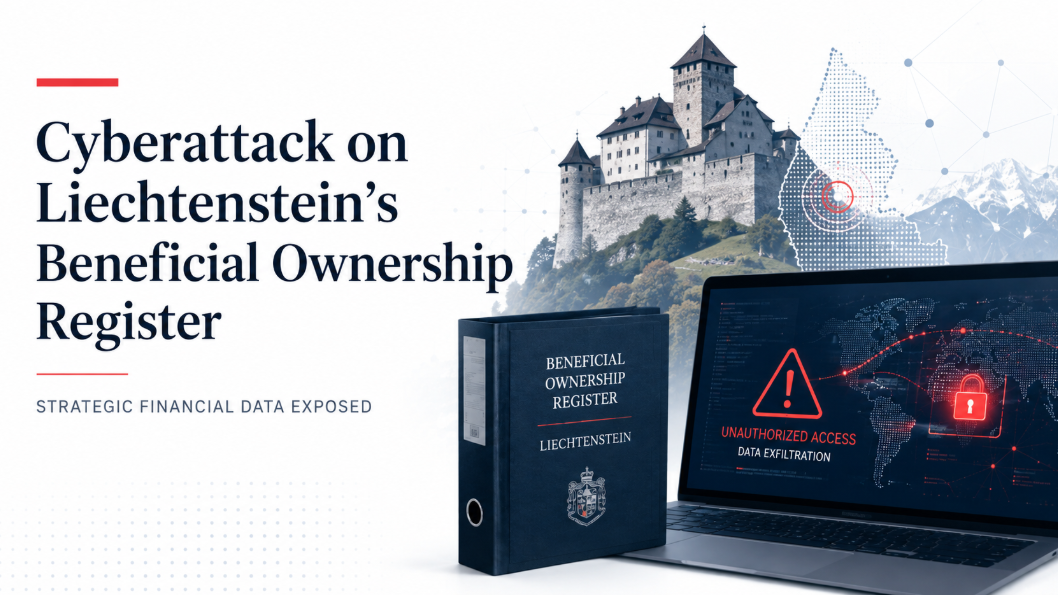
Liechtenstein has confirmed a serious cyberattack against its Register of Beneficial Owners, a government database used to identify the individuals who ultimately own or control companies, foundations and trusts.
According to the government, an unknown threat actor gained unauthorised access to the system during the night of 30 July 2026 and extracted copies of data connected to approximately 31,000 legal entities. The figure refers to registered companies, foundations and trusteeships – not necessarily to 31,000 individual people, as initially reported by some international media.
The affected system, known locally as the Verzeichnis wirtschaftlich berechtigter Personen or VwbP, forms a central component of Liechtenstein’s framework for combating money laundering, predicate offences and terrorist financing. It contains information linking legal entities to their beneficial owners and is used by authorities and regulated financial institutions for due-diligence and transparency purposes.
Attack detected through operational anomalies
Employees at the Office of Justice detected irregularities during 30 July and contacted the Office of Information Technology. Authorities subsequently implemented measures to secure the data, disconnected the affected system from the network and launched a forensic investigation.
The government was informed of a potentially successful compromise on 31 July. Initial confirmed findings were delivered on 1 August, after which a crisis team was activated under the leadership of Prime Minister Brigitte Haas and Justice Minister Emanuel Schädler. External access to the register remains unavailable while the investigation continues.
At the time of disclosure, investigators had found no evidence that records had been altered or deleted. However, confirmed data exfiltration means that the incident primarily affects confidentiality rather than integrity. The initial access vector, attacker identity, dwell time and presence of any persistence mechanisms have not yet been disclosed.
A high-value dataset for criminal intelligence
From a CISO perspective, the significance of the breach extends beyond conventional personal-data exposure. A structured beneficial-ownership database can reveal relationships between individuals, corporations, trusts and financial structures.
When combined with leaked credentials, public corporate records, sanctions data or information from previous breaches, the stolen material could support highly targeted phishing, executive impersonation, fraud, extortion and social-engineering campaigns.
Attackers could also use the information to identify wealthy individuals, politically exposed persons, corporate decision-makers or complex ownership structures. This makes the dataset potentially valuable not only to financially motivated cybercriminals, but also to intelligence services and organised-crime groups.
GDPR notification and incident response
The Liechtenstein government has classified the incident as a personal-data breach under Article 33 of the General Data Protection Regulation. Authorities are preparing notifications to affected persons under Article 34 and have established a central contact point for enquiries.
For security leaders, the incident highlights the importance of treating government and regulatory registers as high-value assets. Protection should include strong privileged-access controls, phishing-resistant multifactor authentication, continuous monitoring of bulk queries, strict segmentation, database activity monitoring and automated detection of unusual extraction patterns.
Organisations whose executives, owners or clients may appear in the register should increase monitoring for impersonation attempts and suspicious account activity. They should also warn potentially affected individuals that attackers may use accurate corporate and ownership information to make fraudulent communications appear highly credible.
The breach demonstrates that transparency systems designed to fight financial crime can themselves become strategic targets. Their security architecture must therefore reflect not only regulatory requirements, but also the intelligence value of the data they aggregate.