

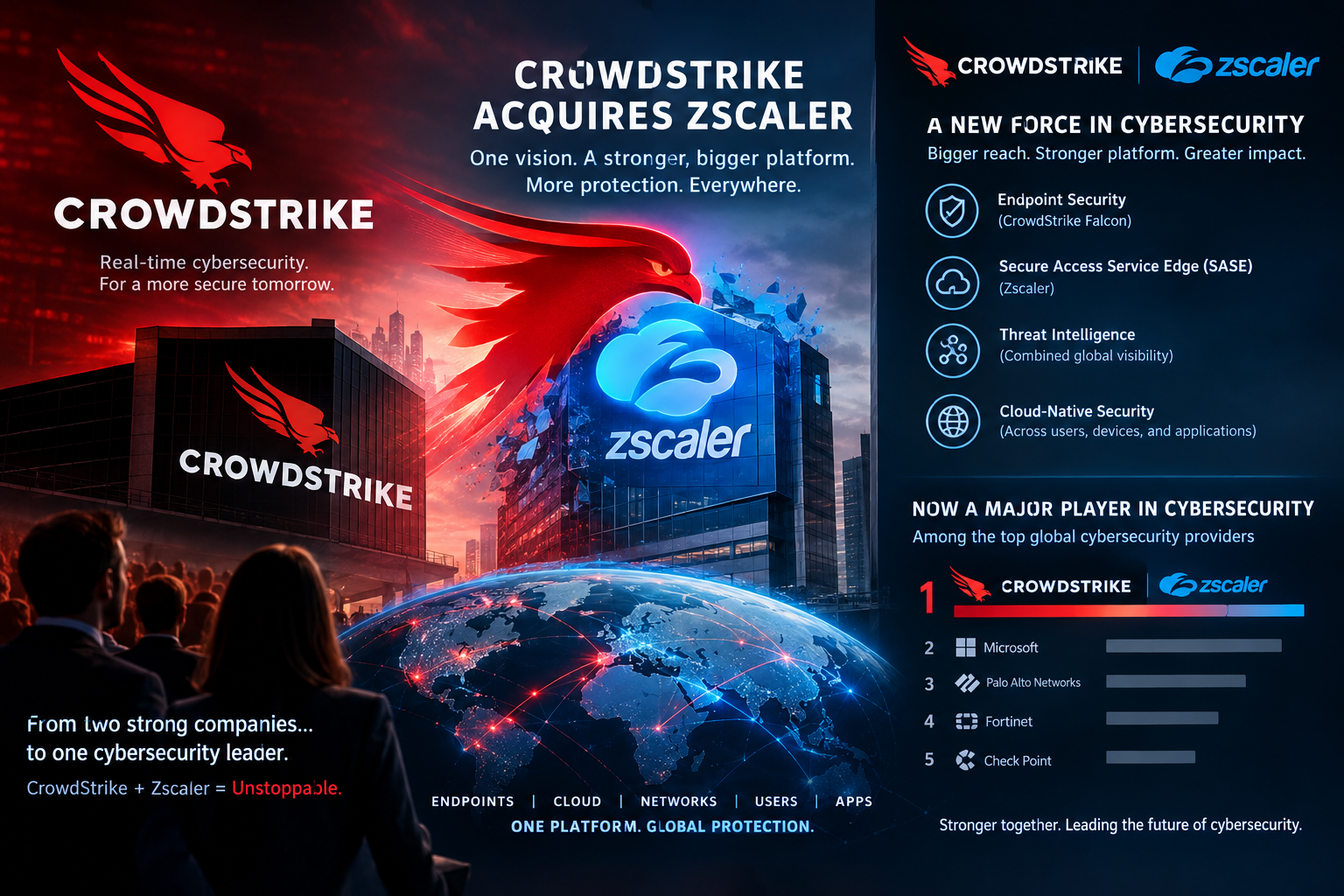
CrowdStrike has agreed to acquire Zscaler in an all-stock transaction valued at approximately $43.9 billion. The combination would integrate Zscaler’s Zero Trust Exchange with CrowdStrike’s Falcon platform, linking endpoint, cloud workload, network access and traffic inspection controls.
The companies expect the deal to improve security response, support AI-agent access controls and generate additional revenue through bundled products. The transaction requires shareholder and regulatory approval, with closing targeted for the second half of fiscal 2028. Boards are advised to assess independent failure, integration, pricing and portability risks.
CrowdStrike has agreed to acquire Zscaler in an all-stock deal with an announced enterprise value of approximately $43.9 billion. Reuters described it as the largest cybersecurity acquisition ever announced. The deal would bring Zscaler’s Zero Trust Exchange into CrowdStrike’s Falcon platform, adding network access enforcement and traffic inspection to its existing endpoint and cloud workload controls. CrowdStrike Holdings, Inc.
The case for joining endpoint and network security
An endpoint alert can tell a security operations center which device or process behaved suspiciously. Network telemetry can show which applications that device accessed and, where inspection is in place, whether sensitive data left the organization. CrowdStrike plans to bring those signals together in Falcon Next-Gen SIEM and sell Zscaler’s products through Falcon Flex. The companies already share more than 2,000 customers, and CrowdStrike sees about 8,000 other Zscaler customers as potential buyers for its products. It projects $1 billion in annualized revenue gains from the combination by 30 months after closing. CrowdStrike Holdings, Inc.
The clearest benefit would be faster containment. An analyst investigating a compromised laptop could see which cloud applications it contacted, restrict its access and verify that the restriction took effect. A credible demonstration would show how much time that saves and whether the same workflow works for customers who use another vendor’s identity platform or SIEM.
AI agents put more pressure on access controls
An AI agent can run in a managed cloud service, call several APIs and act using credentials delegated by a user. In that setting, the health of the device that initiated the request tells only part of the story. A security team needs to identify which agent acted, whose authority it used, which data it could access and which actions required human approval.
Zscaler could give CrowdStrike another place to enforce policy on traffic that passes through its controls. An agent with permission to read customer records, for instance, might need separate authorization to send them to an external service. The application still has to enforce permissions for actions that happen inside the service. That distinction matters most when an agent can change records or trigger transactions. CrowdStrike Holdings, Inc.
What CISOs should ask before consolidating
- Can the security controls fail independently? Ask for a live test that shows how endpoint protection and access enforcement behave when the vendor’s management plane is unavailable. Verify which critical applications remain reachable and how teams recover.
- Can the SOC keep its existing tools? Verify which logs and response actions are available through third-party integrations, where telemetry is stored, and whether customers can opt out of having their telemetry used for model training. CrowdStrike says it plans to use the combined dataset to train its SafeMind security models. CrowdStrike Holdings, Inc.
- Can customers change course at renewal? Ask for standalone and bundled pricing, clear log export terms, and a documented path to replace either service without losing access to historical telemetry.
The terms and timing
Zscaler shareholders are set to receive 1.135 CrowdStrike shares for each Zscaler share, implying $260.41 per share and a roughly 34% premium at 20 November closing prices. CrowdStrike expects the combined business to start with more than $10 billion in annual recurring revenue. The companies target the second half of CrowdStrike’s fiscal 2028 for closing, a window from August 2027 through January 2028. The deal requires Zscaler shareholder approval, regulatory clearances and other customary conditions. sec.gov
For boards weighing the trade-off, two tests matter. Time how quickly the SOC can contain a compromised identity or device, then test whether the business can keep operating and recover if the shared platform is unavailable.