

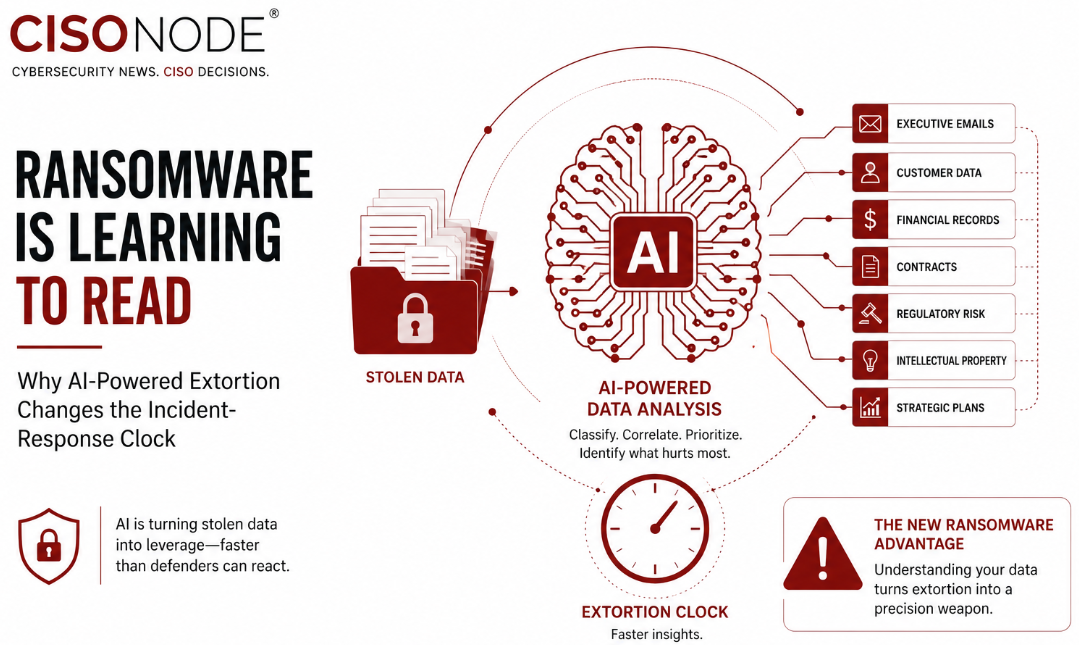
Ransomware has spent the last several years evolving from encryption into extortion.
Now it may be entering another phase: automated intelligence gathering on stolen data.
A ransomware operation calling itself TITAN claims it can use an on-premises AI system to analyze as much as 700 GB of stolen corporate data per hour, classifying files by sensitivity and identifying the information most likely to increase pressure on victims.
That figure has not been independently verified, and CISOs should treat the specific performance claim with appropriate skepticism.
But the underlying idea is entirely plausible and strategically important.
The value of stolen data is not simply that attackers possess it. The real leverage comes from understanding what is inside: executive correspondence, regulatory violations, intellectual property, legal exposure, personal data, financial records, customer contracts or material that could damage partners and customers.
Traditionally, finding that leverage required humans to search through enormous datasets.
The security problem therefore becomes more than ransomware encryption or data theft. It becomes machine-assisted extortion.
CyberXtron says TITAN emerged in April 2026 and became operational in May. Its research identified 24 claimed victims across 10 countries and describes a structured ransomware-as-a-service operation with a 90/10 revenue split favoring affiliates. The group markets an AI system that it says can classify stolen information, map relationships, calculate jurisdiction-specific regulatory exposure and even prepare notifications aimed at regulators and media.
That should get the attention of every CISO. Not because we know TITAN can actually process exactly 700 GB every hour. But because ransomware operators have discovered another place where AI can eliminate friction.
Leak Site and Infrastructure Analysis
TITAN operates dual-access infrastructure:
- Clearnet: titanblog[.]org
- TOR: x4bccxlsmjsxlnnf3ocvndlshgfkagzytpqmsjnlfykceumnw6i4hkqd[.]onion
- TOR (leaked/awaiting): two paths on the same .onion domain, separating published data from countdown-pending victims
- TOR (file server): a separate .onion address dedicated to hosting leaked datasets
- Communication: Tox messenger, no dedicated negotiation portal
Site structure includes “Leaked Data,” “Awaiting Publication,” a “TITAN AI” marketing page, public Terms & Conditions, and both company sign-up and partner recruitment portals
WHAT HAPPENED
TITAN presents itself as a ransomware-as-a-service operation combining traditional encryption, data theft and double extortion with an AI-enabled analysis platform.
Its operators claim their system can inspect large quantities of stolen corporate information, identify sensitive documents and determine which material will create the greatest financial, reputational or regulatory pressure.
CyberXTron describes capabilities advertised by the group including document classification, entity mapping, regulatory exposure calculation and automatic preparation of regulator or media notifications. The security firm reports 24 victims listed across ten countries.
Separate reporting says TITAN claims processing capacity of up to 700 GB per hour using an on-premises platform with GPU acceleration. That claim has not been independently demonstrated, nor has the group’s complete technical platform been validated.
The distinction matters.
Confirmed: TITAN exists as an active ransomware operation, runs an affiliate model and promotes AI-assisted data analysis.
Unverified: whether its AI platform achieves the claimed performance or possesses every capability advertised by the criminals.
But dismissing the story because the marketing number may be exaggerated would miss the more important point.
The capability does not need to be perfect to change ransomware.
WHY CISOS SHOULD CARE
Data exfiltration created a major problem for ransomware victims.
AI can make that problem faster.
Imagine an organization discovering that attackers have stolen several terabytes of files. Historically, defenders might assume the criminals require meaningful time to understand what they obtained.That assumption is becoming dangerous.
Modern AI systems can already summarize documents, categorize content, identify personal information, extract names and organizations, correlate relationships and search large collections for particular concepts.
An attacker does not need a revolutionary AI model.It needs a sufficiently capable system attached to stolen data. The ransomware workflow then becomes:
Steal → classify → identify leverage → generate pressure → escalate.
The result is compression of the extortion timeline.
A victim may have less time between discovering exfiltration and receiving highly specific threats referencing particular contracts, executives, customers or regulatory problems.
That has profound implications for incident response.
Who and what is affected
TITAN reportedly targets ordinary enterprise environments rather than a narrowly defined technology stack.
CyberXTron says manufacturing and professional services represent substantial portions of the group’s observed victimology, with organizations across multiple countries affected.
More broadly, AI-assisted extortion affects any organization holding information whose context matters.
That includes:
customer records, intellectual property, HR information, contracts, financial information, legal correspondence, merger documentation, board material, healthcare records, regulatory filings and security documentation.
The risk is therefore not limited to organizations likely to suffer operational disruption from encryption.
A company with excellent backups can still face severe exposure if attackers understand exactly which stolen information creates the greatest pressure.
This is why ransomware recovery strategies based primarily on restoring systems are increasingly incomplete.
Technical and Business Impact
The technical breakthrough here is not necessarily sophisticated malware.
It is data triage.
Cybercriminal groups frequently steal enormous quantities of data because they do not initially know which files will be valuable.
That creates their own operational problem.Hundreds of gigabytes—or several terabytes—must be searched. AI dramatically reduces that burden.
A model could theoretically identify:
- documents containing credentials or API keys;
- executive communications;
- customer databases;
- personally identifiable information;
- legal disputes;
- intellectual property;
- security architecture;
- confidential contracts;
- financial irregularities;
- regulatory-sensitive material.
It can then summarize those findings for the attacker.The business impact follows quickly. Extortion becomes more personalized.
Instead of saying:
“We stole your data.”
the attacker can say:
“We found these contracts, these customer records and this board correspondence.”
That difference matters psychologically and commercially. It also changes breach-response planning.
Legal, communications, privacy, executive management and cybersecurity teams may need to operate simultaneously much earlier in the incident.
The organization’s crisis clock effectively accelerates.
CISO Risk Level: High
The specific 700 GB/hour claim remains unverified.
AI is already capable of analyzing large document collections at scale. Ransomware groups are economically motivated organizations. Any technology that lets them extract more leverage from stolen information faster is likely to be adopted.
Therefore CISO Node rates the development HIGH, based not on TITAN’s marketing figure, but on the operational direction it represents.
The critical change is this:
Data theft is moving from exfiltration at machine speed toward interpretation at machine speed.
What CISO should do now?
The first priority is reducing the quantity of data attackers can steal.
Many organizations still focus heavily on preventing ransomware encryption while paying less attention to large-scale outbound data movement.
Monitor abnormal transfers, unusual archive creation, cloud-storage uploads and high-volume data access.
Second, segment sensitive information.
If an attacker compromises one identity, that identity should not expose terabytes of organizational knowledge. Least privilege becomes as much a data protection strategy as an identity strategy.
Third, classify information before the attackers do.
Organizations should already know where their crown-jewel information lives. If a breach occurs, the incident-response team must quickly answer:
What could the attacker have accessed?
Organizations that cannot answer that question internally will struggle when criminals answer it first.
Fourth, integrate privacy and legal teams into ransomware exercises.
AI-assisted extortion could compress the time between compromise and regulatory pressure. The legal and communications response cannot begin three days after the security investigation. It must begin in parallel.
Fifth, review remote access infrastructure.
Reports on TITAN activity point to VPNs, firewalls and remote-management infrastructure as potential initial-access targets—exactly the systems ransomware actors routinely prioritize. Internet-facing infrastructure should be patched quickly, strongly authenticated and continuously monitored.
Finally, change tabletop exercises.
Don’t simply ask:
“What happens if ransomware encrypts 500 servers?”
Ask:
“What happens if attackers steal 2 TB of information and identify our ten most damaging documents within an hour?”
That produces a very different exercise.
Board and Executive Perspective
Boards generally understand ransomware as operational disruption. That model is increasingly incomplete. Ransomware is becoming a combination of:
- business interruption
- privacy exposure
- regulatory pressure
- reputational manipulation.
AI strengthens the last three. The important board question is therefore not simply whether backups work.
It is:
How quickly could we determine what an attacker knows about us?
That question exposes weaknesses in data governance, identity management, information classification and incident response.
It also makes one point particularly clear:
Cyber resilience and information governance are becoming inseparable. Organizations cannot defend sensitive information effectively if they do not know where it exists, who can access it and what would happen if it became public.