

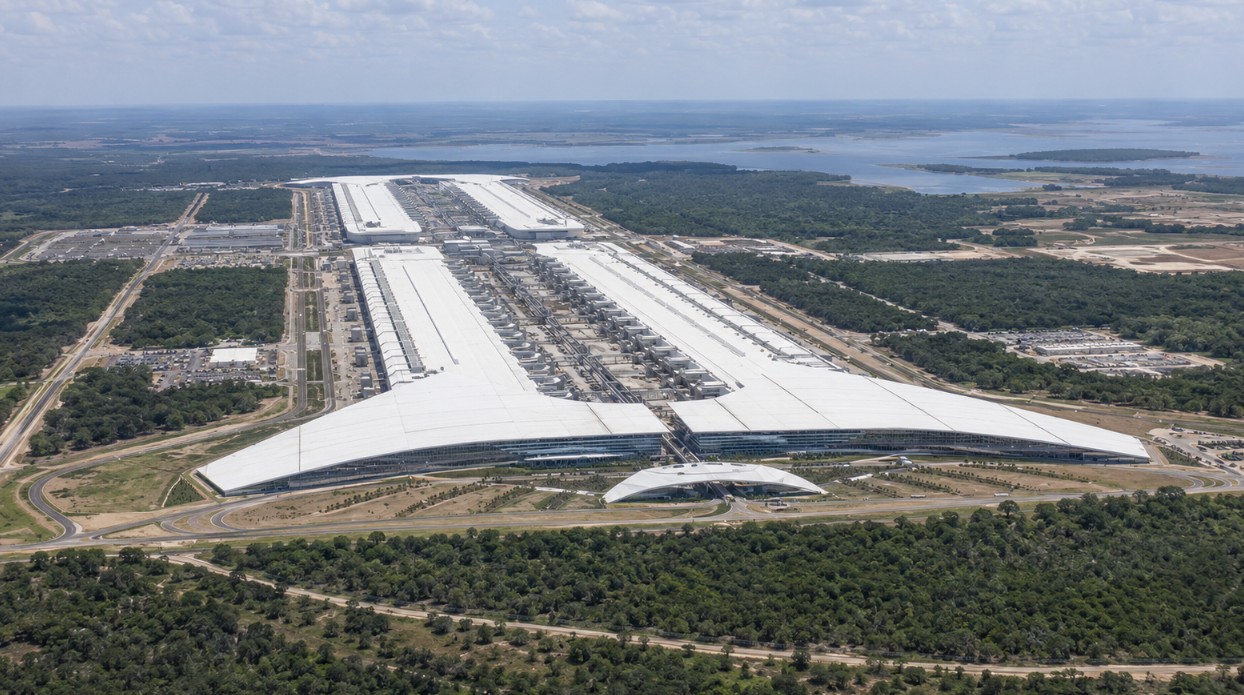
Tesla, SpaceX and Intel are attempting the largest vertically integrated semiconductor project ever announced. Whether or not it succeeds, it exposes a dependency most security programmes have never mapped.
For most of the past decade, the argument about artificial intelligence was an argument about models. Whose was largest, whose reasoned best, whose agents ran furthest without supervision. It was a software conversation, and security teams engaged with it on software terms: prompt injection, data leakage, model governance, third-party risk questionnaires with a new AI annex bolted on.
That conversation is quietly being overtaken by a heavier one. AI now competes for electricity, land, water, grid interconnects, advanced packaging capacity, high-bandwidth memory and skilled process engineers. The constraint has moved from cleverness to concrete.
On 6 August 2026, that shift acquired an address. Tesla and SpaceX confirmed that Terafab — the semiconductor complex Elon Musk first floated in March — will be built in Grimes County, Texas, about an hour northwest of Houston. The first phase carries roughly $16.8 billion in capital investment and a commitment to at least 3,000 jobs. Texas extended a $30 million Enterprise Fund grant and qualified the project under its Jobs, Energy, Technology and Innovation programme, after county commissioners voted 4–1 in June to designate a reinvestment zone covering more than 22,000 acres around the Gibbons Creek Reservoir.
The finished site is planned to exceed 100 million square feet — roughly 9.3 million square metres. Musk has called it the largest and most valuable building on Earth. The site itself has a certain symbolism: the reservoir once cooled a coal-fired power station that shut down in 2018, and SpaceX has committed to drawing industrial water from it rather than from local groundwater, in a county already uneasy about the data centres spreading across Texas.
The scale is arresting. It is also not the interesting part.
From fab to Terafab
Modern chipmaking is a masterpiece of fragmentation. A single accelerator may be designed in California, fabricated in Taiwan, fitted with memory from South Korea, packaged by a third party, tested by a fourth and integrated into systems by a fifth — using lithography equipment that essentially one Dutch company knows how to build. The model produced extraordinary specialisation and extraordinary efficiency. It also produced extraordinary dependency. Nvidia, Apple and AMD are all, in the end, customers of someone else’s factories.
Terafab proposes the opposite. Logic, memory, advanced packaging and testing are to sit under one roof, coordinated as a single industrial system rather than a supply chain. Tesla’s stated reasoning is blunt: both companies expect to need far more silicon than current and projected global production can supply, so they intend to build the capacity rather than queue for it.
The demand case is not hypothetical. Tesla needs inference silicon for Full Self-Driving, Cybercab and – if the roadmap holds – Optimus units in volumes that would dwarf automotive semiconductor norms. xAI needs training and serving compute. SpaceX has been increasingly explicit about moving AI infrastructure into orbit, where solar energy is abundant and terrestrial constraints on power, cooling, land and permitting do not apply, at the cost of radiation tolerance, thermal management and communications problems that would demand purpose-built processors.
Read together, the strategy is coherent: stop competing for capacity, and own it instead.
Intel’s role, and why it matters
The most consequential development was not the Texas site selection but what happened in April. Intel joined the project, and Tesla committed to Intel’s forthcoming 14A process node, becoming the first named external customer for a technology Intel had publicly threatened to abandon without one. Intel’s CEO had said plainly that the company would exit contract manufacturing if it could not find a meaningful outside buyer to justify the capital.
Each side gets something it cannot manufacture on its own timeline. Intel gets validation for a foundry strategy that had been running on promises. Musk’s companies get decades of accumulated process engineering, packaging capability and industrial infrastructure that no amount of capital compresses into a few years. Terafab teams have reportedly been in discussion with the wider equipment ecosystem as well — deposition, etch, metrology, lithography-adjacent processes.
This is the correct frame for the project. Terafab is not an attempt to reinvent semiconductor manufacturing from first principles. It is an attempt to assemble an entire ecosystem around one group of companies’ future silicon requirements.
Why a Texas fab belongs on a European CISO’s radar
The obvious objection is that none of this is a security problem. A fab in Grimes County has no line in anyone’s risk register, and there is no control to implement on Monday morning.
The objection holds for about as long as it takes to notice that security tooling has become AI tooling. Detection engineering, malware analysis, identity analytics, vulnerability prioritisation, SOC automation and autonomous remediation all now consume accelerator capacity, either in your environment or in your vendor’s. Semiconductor availability has quietly become an input to security availability. When a vendor cannot get silicon, your detection roadmap slips with theirs — and you will hear about it as a feature delay, not a supply chain event.
That makes Terafab worth watching for four reasons.
1. The hardware supply chain is the next software supply chain
Security leaders spent the last five years learning to reason about software provenance: SBOMs, dependency confusion, build system integrity, signed artefacts. The hardware equivalent is less mature and considerably harder. Trust in a chip begins below the operating system, and compromise can be introduced at design, firmware, fabrication, packaging or distribution. None of those failure modes are visible to an EDR agent, and none of them are addressed by a supplier attestation that says “we take security seriously.”
As organisations bind their operations to AI infrastructure, the provenance, integrity and availability of processors become first-order security properties rather than procurement footnotes. Very few programmes currently have a defensible answer to a simple question: where did the silicon in our AI stack come from, and what would we do if we could not get more of it?
2. Vertical integration relocates risk rather than removing it
Terafab’s model reduces exposure to external suppliers, which genuinely improves certain kinds of resilience. But concentration is the mirror image of independence. When one industrial ecosystem spans chip design, fabrication, packaging, AI models, satellite communications, autonomous vehicles and humanoid robotics, a compromise reaching the shared layer propagates across a startling range of technologies at once.
Security architects will recognise the trade-off from smaller contexts — collapsing three mediocre vendors into one excellent one is usually right, and occasionally catastrophic. Reducing third-party dependency does not reduce systemic risk. It moves the risk inside the perimeter, where it becomes someone’s internal control failure instead of someone’s contract.
3. Advanced fabs are among the highest-value targets on Earth
The intellectual property inside a leading-edge facility — process recipes, chip designs, yield optimisation data, equipment configurations, tool firmware, roadmap detail for unreleased processors — represents decades of accumulated knowledge that cannot be reconstructed from capital. For state-aligned actors, that is an intelligence target of the first rank. For financially motivated groups, the disruption leverage is close to unlimited, because a fab that stops does not simply resume.
Defending such a site requires IT security, OT security, manufacturing resilience, physical security, supplier assurance and aggressive IP compartmentalisation operating as one programme rather than five. The person accountable for security at a semiconductor mega-facility is not protecting an office network. They are protecting industrial capability, and the failure modes are measured in quarters.
4. AI agents become privileged identities in industrial environments
Terafab is an early example of a broader convergence: AI infrastructure is becoming industrial infrastructure, and the categories security teams use to separate them are dissolving. A facility of this type will run industrial robotics, autonomous logistics, AI-driven process optimisation, digital twins, specialised OT networks and thousands of supplier integrations — increasingly with software agents holding real authority over parts of the production lifecycle.
The identity implications deserve more attention than they get. Security teams already manage human identities and machine identities. They are now acquiring a third category: agent identities, with permissions, delegated authority and the ability to act at machine speed across environments that were historically segmented from each other. An autonomous agent permitted to adjust manufacturing parameters is, in any meaningful sense, more privileged than most human administrators in the same plant — and it is unlikely to be governed with anything like the same rigour.
That is not a Texas problem. It is arriving in every organisation deploying agentic AI against operational systems, and Terafab simply makes it visible at maximum scale.
Semiconductor sovereignty is becoming AI sovereignty
There is a geopolitical layer here that European readers will feel more sharply than American ones. The specialisation that made semiconductors cheap — US design leadership, Taiwanese fabrication, Dutch lithography, Japanese materials, Korean memory — also made them fragile, and governments have spent several years reclassifying advanced chip capacity from economic asset to strategic infrastructure.
Terafab sits inside that trend with one important difference: it is not industrial policy. It is private vertical integration driven by one group’s projected demand. If it works even partially, it produces a new category of organisation — one that owns meaningful portions of the chain from energy generation and chip fabrication through to AI models, autonomous machines and orbital communications. Regulators built for companies that do one thing will find that difficult to supervise, and so will third-party risk functions built for vendors that do one thing.
The reasons for scepticism are substantial
None of this is a prediction of success. Leading-edge semiconductor manufacturing is among the hardest engineering disciplines humanity practises, and the gap between building a facility and achieving competitive yields has ruined better-capitalised efforts than this one. TSMC’s advantage is not its buildings; it is thirty years of process knowledge that capital does not purchase.
The published numbers deserve the same scepticism. The one-terawatt figure refers to deployed compute capacity enabled annually by Terafab silicon, not the plant’s own power draw — and Bernstein has estimated that building infrastructure at that scale would require somewhere between $5 trillion and $13 trillion in capital expenditure. The frequently quoted $119 billion total buildout is a long-term scenario across all phases, not a commitment. SpaceX’s own IPO filing in May characterised the Terafab arrangement as a general framework carrying no binding obligations, with either party free to walk away.
There is local friction, too. Hundreds of residents raised objections over tax incentives and transparency at a county meeting the day before the announcement, and questions about water, grid load and public subsidy will intensify as construction proceeds.
Treat the numbers as ambition. Treat the direction as real.
The question that changes
The AI industry has organised itself around four questions: who has the best model, the most GPUs, the most data, the most compute. Terafab introduces a fifth, who can manufacture the compute, and that one may prove the most durable, because it is the only one that cannot be answered by writing a cheque this quarter.
If Tesla, SpaceX and xAI secure dedicated capacity at anything approaching the announced scale, the advantage they gain is not cheaper silicon. It is architectural independence: chip design evolving in lockstep with model architecture, manufacturing tuned to robotics requirements, data-centre design co-developed with the processors it houses, and eventually orbital compute designed alongside the silicon that powers it. Competitors can buy chips. They cannot buy that.
For security leaders, the practical takeaway is narrower and more immediate. Add hardware provenance and silicon availability to the supply chain conversation you are already having. Ask your AI vendors where their compute comes from and what their contingency is. Start treating agent identity as a distinct governance problem rather than an extension of service accounts. And accept that some of the most consequential security decisions of this era are being made a long way upstream of anything you can patch.
They are being etched into silicon.