

The explosive rise of artificial intelligence tools has created a new and dangerous attack surface for cybercriminals. In the latest example, attackers are now weaponizing the trust and hype surrounding AI platforms to distribute sophisticated malware capable of giving remote access to compromised systems.
Security researchers have uncovered a malicious campaign leveraging a fake version of Claude to deploy a previously undocumented Windows backdoor called “Beagle.” The operation demonstrates how threat actors are rapidly adapting their tactics to exploit the growing dependency on AI tools inside enterprises, development teams, and research environments.
AI Hype Becomes a New Social Engineering Weapon
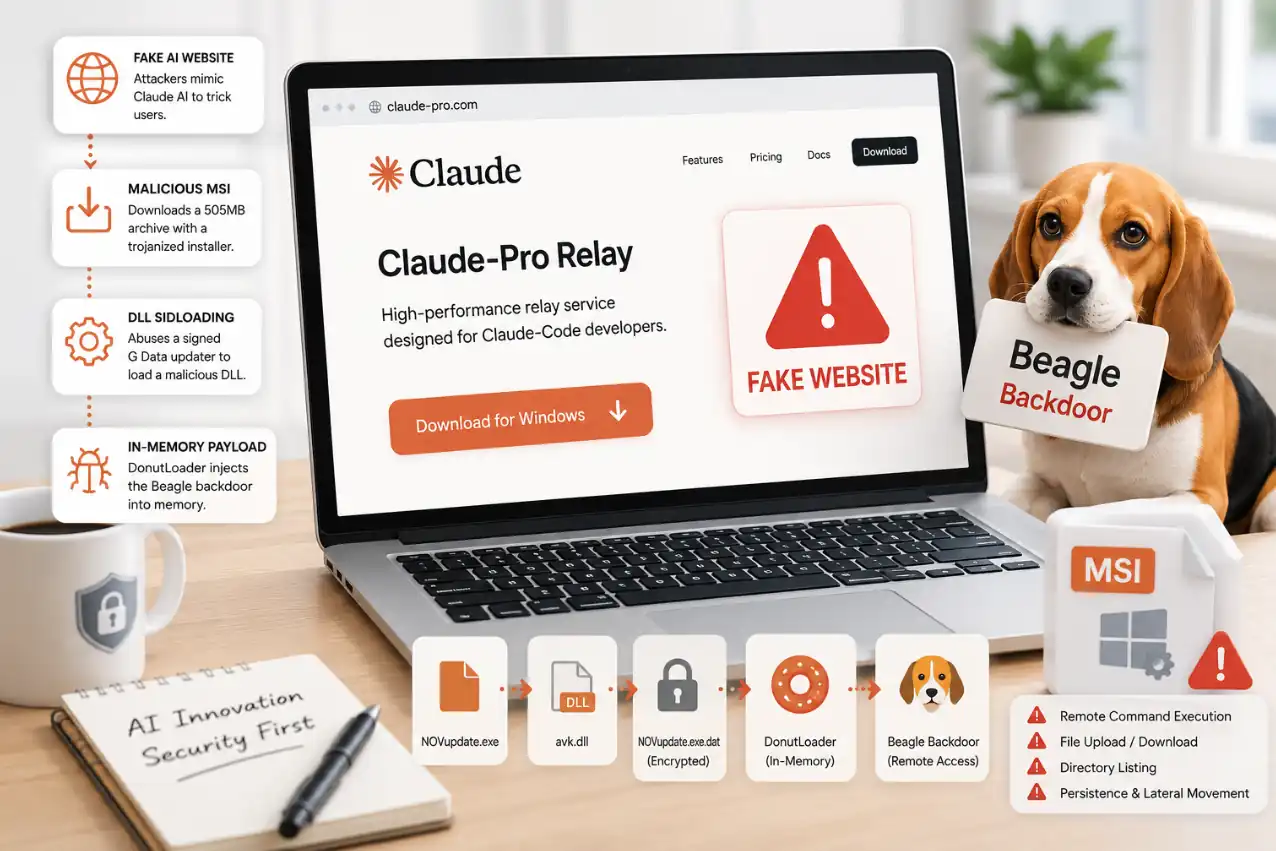
According to research published by BleepingComputer and further analyzed by researchers at Sophos, attackers created a fraudulent website impersonating Claude AI using a domain named claude-pro[.]com.
The fake portal promoted a so-called “Claude-Pro Relay” product, advertised as a high-performance relay service for developers working with Claude-Code environments. The website visually mimicked the branding, fonts, and color palette of the legitimate Claude ecosystem, making the scam highly convincing at first glance.
However, behind the polished facade was a malware delivery platform designed to compromise Windows endpoints.
This attack is particularly dangerous because it targets exactly the type of audience currently experimenting with AI:
- developers,
- security engineers,
- automation teams,
- researchers,
- and technically curious users.
These users are often willing to install experimental AI tools quickly, sometimes bypassing normal verification procedures.
The Infection Chain
Victims downloading the fake “Claude-Pro” package received a massive 505MB ZIP archive containing a malicious MSI installer.
Once executed, the installer deployed several suspicious files into the Windows Startup folder:
-
NOVupdate.exe -
NOVupdate.exe.dat -
avk.dll
The campaign initially appeared to distribute the well-known PlugX malware family. However, deeper forensic analysis revealed an additional previously undocumented payload now referred to as “Beagle.”
Sophos researchers discovered that the infection chain used:
- DLL sideloading,
- encrypted payload staging,
- in-memory execution,
- and signed binaries abuse.
These are all techniques commonly associated with advanced persistent threat (APT) operations and sophisticated cyber espionage campaigns.
Abuse of Trusted Security Software
One of the most concerning elements of the attack is the use of a legitimate signed executable linked to G Data security software.
Attackers abused the trusted executable NOVupdate.exe to sideload a malicious DLL (avk.dll) which then decrypted and executed an encrypted payload entirely in memory.
This technique significantly reduces detection visibility because:
- no obvious malicious executable is written to disk,
- endpoint protection systems may trust signed binaries,
- and the final payload executes mainly in memory.
The decrypted payload was identified as Donut, an open-source in-memory injector often seen in offensive security frameworks and advanced malware operations.
Donut then injected the final Beagle backdoor directly into memory.
What the Beagle Backdoor Can Do
Although Beagle appears simpler than some modern malware families, it still provides attackers with dangerous remote administration capabilities.
The malware supports commands including:
- remote command execution,
- file upload/download,
- directory listing,
- file deletion,
- directory creation,
- renaming operations,
- and self-uninstallation.
In practice, this allows attackers to:
- establish persistence,
- steal sensitive information,
- deploy additional payloads,
- move laterally,
- or stage ransomware operations.
The malware communicates with its command-and-control infrastructure using encrypted traffic over TCP and UDP channels, making network detection more difficult.
Why This Campaign Matters
This campaign represents a larger strategic shift in cybercrime.
Attackers are no longer simply impersonating banks, Microsoft portals, or delivery services. They are now exploiting the global AI boom itself.
Artificial intelligence tools have become:
- highly trusted,
- heavily searched,
- frequently downloaded,
- and often used with elevated permissions.
This makes them ideal lures for malware distribution.
The timing is also critical. Many organizations are currently deploying AI solutions faster than governance and security controls can mature. Employees may independently download AI-related tools without formal validation by IT or security teams.
This creates a dangerous “shadow AI” ecosystem similar to the shadow IT problems seen years ago with unauthorized SaaS adoption.
Indicators of a Broader Operation
Researchers also linked additional malware samples and related infrastructure to:
- fake update portals,
- impersonated cybersecurity vendors,
- decoy PDFs,
- and modified Microsoft Defender binaries.
Some infrastructure was reportedly hosted through cloud resources associated with Alibaba Cloud.
The overlap with historical PlugX tradecraft suggests that experienced operators may be experimenting with new modular payloads and delivery chains.
This evolution is significant because it indicates malware developers are modernizing old attack frameworks to align with AI-themed social engineering.
Strategic Takeaways for CISOs
For security leaders, this incident highlights several critical realities:
1. AI Adoption Introduces New Enterprise Risk
AI governance must now include:
- software validation,
- approved AI tool registries,
- domain reputation monitoring,
- and endpoint controls for AI-related downloads.
2. Developers Are Becoming High-Value Targets
Threat actors increasingly target:
- developers,
- DevOps engineers,
- AI researchers,
- and cybersecurity professionals.
These users often possess elevated privileges and access to critical systems.
3. Signed Binary Abuse Continues to Grow
Traditional trust models based solely on signed executables are no longer sufficient.
Organizations should strengthen:
- behavioral detection,
- memory analysis,
- DLL sideloading monitoring,
- and anomaly-based EDR analytics.
4. AI-Themed Phishing Will Explode
As AI platforms become mainstream, attackers will increasingly impersonate:
- AI assistants,
- AI plugins,
- AI browser extensions,
- AI productivity tools,
- and AI coding frameworks.
This trend will likely accelerate dramatically during the next 12–24 months.
Recommended Defensive Actions
Organizations should immediately:
- block access to suspicious AI-related domains,
- educate employees about fake AI software portals,
- monitor Startup folder modifications,
- detect DLL sideloading attempts,
- inspect unusual outbound traffic over UDP/8080,
-
and hunt for indicators involving
NOVupdate.exeandavk.dll.
Security teams should also validate that users download AI software only from official vendor portals.
Final Thoughts
The fake Claude malware campaign is not just another phishing operation — it is an early warning sign of a much larger cybersecurity trend.
Artificial intelligence is rapidly becoming both:
- a transformative business technology,
- and one of the most powerful social engineering themes ever used by cybercriminals.
Organizations rushing into AI adoption without strong governance frameworks may unknowingly open entirely new attack vectors across their environments.
The Beagle backdoor campaign demonstrates a simple but important reality:
Attackers follow trust.
And right now, the world trusts AI.