

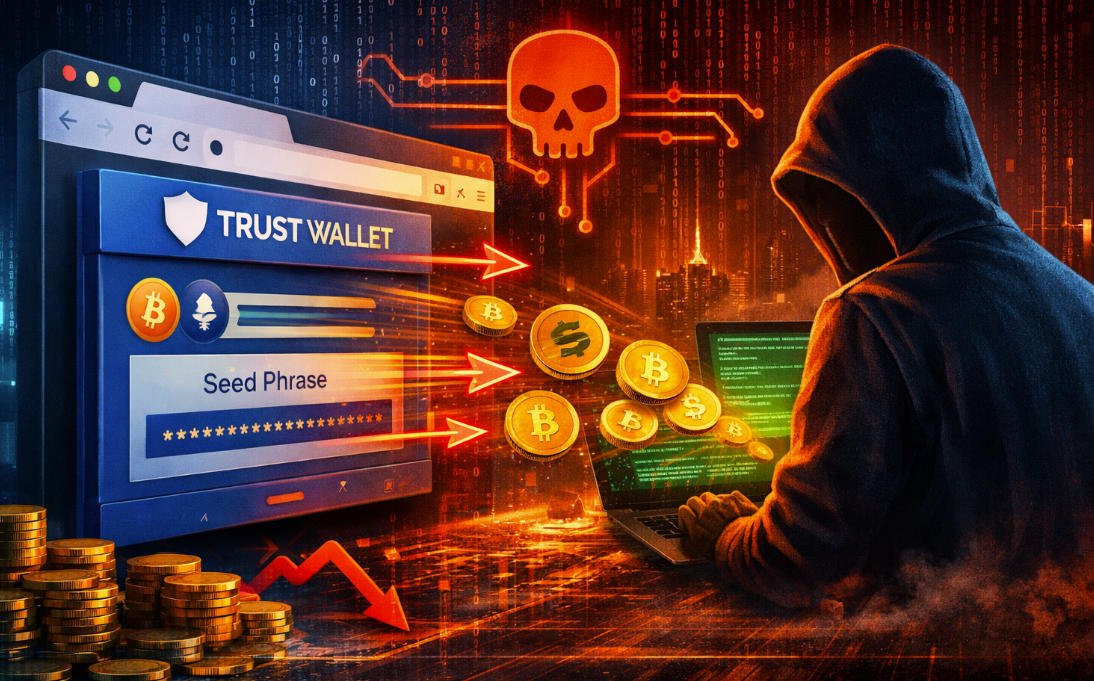
In December 2025, the cryptocurrency ecosystem was shaken by one of the most insidious wallet compromises seen in recent years. Trust Wallet, a Binance-backed and widely trusted self-custody wallet, disclosed that its Chrome browser extension had been compromised through malicious code injected directly into an official release. Unlike phishing campaigns or user-initiated signing attacks, this incident required no user mistake and left almost no visible trace until funds were already gone.
For CISOs and security leaders, this case represents a critical warning: modern attacks increasingly target trusted client-side software, where traditional enterprise security controls offer little visibility or protection.
How the compromise unfolded
On December 24, 2025, Trust Wallet released version v2.68.0 of its Chrome extension. Embedded within this official build was a malicious JavaScript payload that appeared, on the surface, to be a legitimate analytics or metrics module. In reality, the code was designed to intercept one of the most sensitive secrets in crypto security: the seed phrase.
Once users installed or updated to this version and accessed or imported their wallet, the malicious code silently captured mnemonic phrases and transmitted them to attacker-controlled domains. These domains had been registered only days earlier and were deliberately labeled with names that mimicked Trust Wallet infrastructure, such as “TrustWallet Metrics” or “TrustWallet Metrics API,” helping the traffic blend in and evade suspicion.
From that moment, the attack no longer required interaction with the victim. With seed phrases in hand, the attackers simply restored the wallets on their own systems and began draining funds as if they were the legitimate owners.
Why this attack was uniquely dangerous
What makes this incident particularly alarming is not just the financial loss- estimated at around USD 7 million –but the complete collapse of all downstream security controls. Seed phrases are the cryptographic root of trust in self-custody wallets. Once exposed, there is no concept of revocation, no multi-factor authentication to fall back on, and no meaningful way to distinguish an attacker from a legitimate user at the blockchain level.
This is why victims reported funds disappearing even when wallets were closed, devices were idle, or no transactions had been approved. From the blockchain’s perspective, everything looked valid.
Equally troubling was the stealth of the operation. Because the compromise lived inside a trusted browser extension, endpoint security tools, network monitoring, and user awareness measures were largely ineffective. This was not a noisy exploit; it was a silent abuse of trust.
Scope and financial impact
The stolen assets spanned multiple ecosystems, including Bitcoin, Solana, BNB Smart Chain, and several EVM-compatible Layer-2 networks. Attackers rapidly laundered funds through a mix of centralized and semi-centralized services, including instant swap platforms and major exchanges, making real-time loss assessment difficult in the early hours of the incident.
Market reaction was swift. Trust Wallet’s native token, TWT, briefly dropped to its lowest level in months before stabilizing. For users, however, the damage was already done.
Trust Wallet’s response
On December 26, 2025, Trust Wallet publicly confirmed the breach, removed the malicious code, and released version v2.69.0 of the Chrome extension. Users were urged to upgrade immediately. In parallel, the company stated that it would fully compensate affected users, although specific details of the reimbursement mechanism were not immediately disclosed.
While the response was relatively fast, the incident highlights a deeper issue: even reputable providers with strong brand trust can become vectors for large-scale compromise if their build or distribution pipeline is breached.
Strategic lessons for CISOs
From a CISO perspective, this incident sits squarely at the intersection of supply-chain security and endpoint risk. Browser extensions – especially those handling credentials, keys, or wallets – must be treated as privileged software. Automatic updates, opaque code changes, and embedded third-party modules significantly expand the attack surface.
Perhaps the most important takeaway is conceptual: in crypto, incident response is mostly preventive. Once private keys or seed phrases are exposed, recovery options are extremely limited. This shifts the security emphasis away from detection and remediation toward trust minimization, isolation, and architectural restraint.
The broader implication
The Trust Wallet hack should permanently dispel the myth that self-custody failures are always caused by careless users. Here, users did everything “right” – and still lost funds. The real failure occurred higher up the trust chain, where compromised software was implicitly assumed to be safe.
For CISOs overseeing digital assets, fintech platforms, or even employee crypto exposure, the message is clear:
if you trust the update mechanism, you inherit its risk.
In 2026 and beyond, browser extensions and client-side wallets deserve the same scrutiny once reserved only for backend systems and cloud infrastructure.