

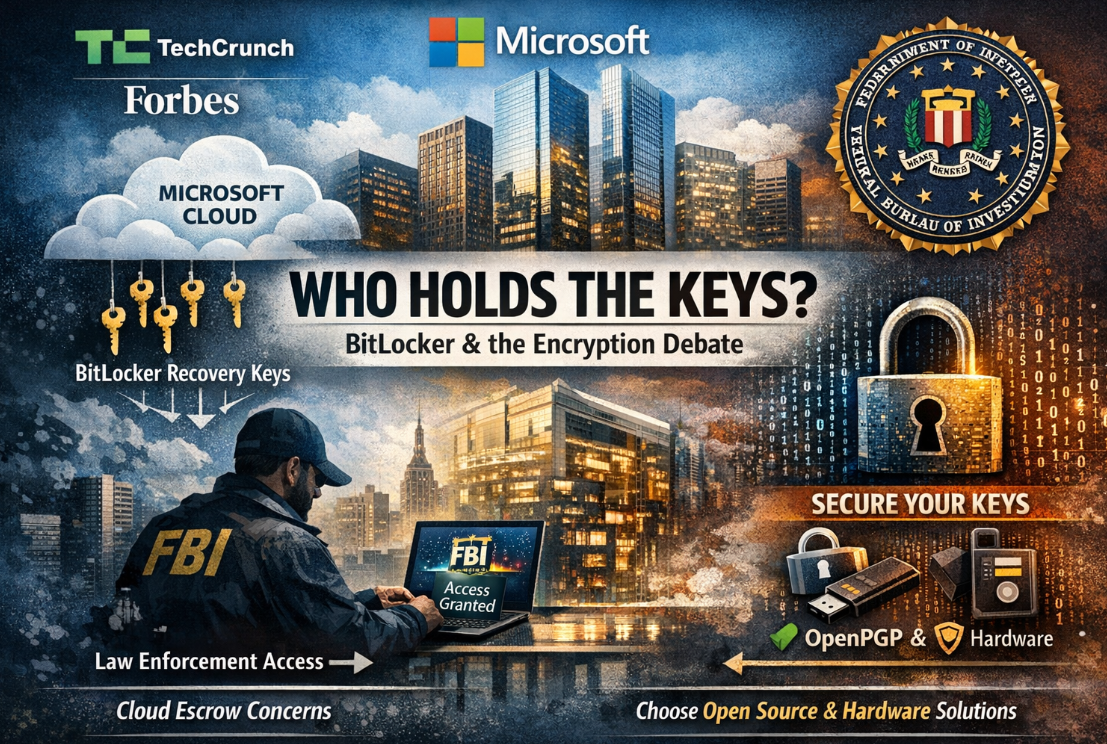
Recent reporting by TechCrunch and Forbes has reignited a long-standing but often underestimated debate: who really controls encryption keys in modern enterprise environments? According to these reports, Microsoft provided the Federal Bureau of Investigation with BitLocker recovery keys to unlock laptops seized during a U.S. federal investigation.
At the center of the discussion is BitLocker, Microsoft’s full-disk encryption technology, enabled by default on most modern Windows devices. While BitLocker is designed to protect data at rest, its default configuration uploads recovery keys to Microsoft’s cloud. This design choice means that, under lawful request, Microsoft can technically retrieve and provide those keys to authorities.
Security vs. Control: A CISO Perspective
From a compliance standpoint, Microsoft’s actions align with legal obligations. However, for CISOs and security leaders, the incident highlights a deeper strategic issue: encryption without exclusive key ownership is not true end-to-end protection. If recovery keys are escrowed in a vendor cloud, the trust boundary extends far beyond the organization.
Even the Cryptography expert Matthew Green from Johns Hopkins University has repeatedly warned about this model. His concern is not limited to law enforcement access, but also to the systemic risk of cloud compromise. Should an attacker gain access to a centralized key repository, encrypted disks could become vulnerable, provided physical access to the device is obtained.
For maximum security, prefer an open, peer-reviewed encryption standard like OpenPGP (PGP) where you control the private keys:not a vendor cloud. In practice, this means generating your own key pairs (ideally on hardened devices or hardware tokens), keeping private keys strictly offline or hardware-protected, and using PGP to encrypt files/emails so only intended recipients can decrypt them. Where operational complexity is too high, choose enterprise products that support customer-managed keys (CMK/HSM) and strict key-escrow governance, ensuring that decryption remains technically impossible without your explicit authorization.
Why This Matters Now
In an era defined by zero trust, regulatory pressure (GDPR, NIS2), and increasing executive reliance on laptops containing sensitive data, default encryption settings deserve renewed scrutiny. Many organizations assume that “BitLocker enabled” equals “data inaccessible to anyone else.” As this case shows, that assumption is incomplete.
Practical Recommendations for CISOs
- Review BitLocker key escrow policies: Disable automatic cloud key backup where possible, or redirect escrow to enterprise-controlled systems.
- Adopt customer-managed keys (CMK) and hardware-backed key storage (TPM + HSM).
- Update endpoint security policies to clearly define who can technically decrypt corporate devices.
- Educate executives and legal teams on the difference between encryption and exclusive key ownership.
Final Thought
Encryption is only as strong as the governance around its keys. For CISOs, this incident is less about Microsoft or the FBI, and more about reclaiming architectural control over the last line of defense: the keys themselves.