

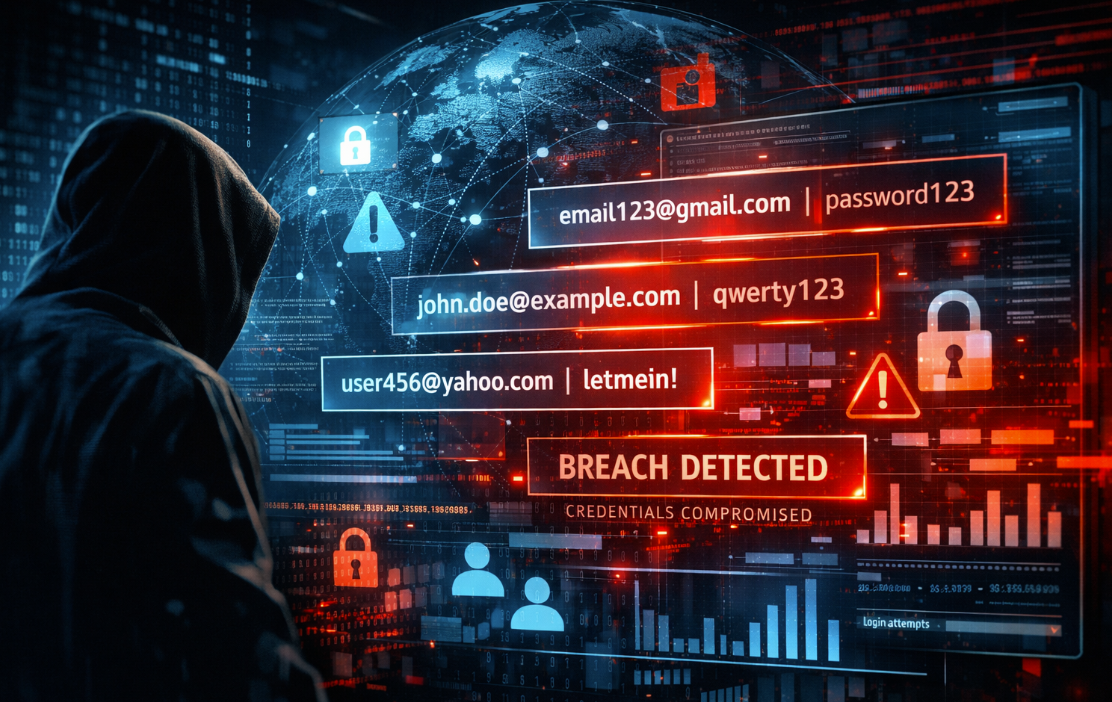
The recent disclosure of a publicly exposed database containing 149 million unique login credentials, including an estimated 48 million Gmail accounts, is not “just another breach.”
It is a strategic signal: one that CISOs, CIOs, and IT leaders must read carefully. The incident, uncovered by veteran security researcher Jeremiah Fowler and reported by Forbes, highlights a deeper and more uncomfortable truth: credential compromise has become a persistent background condition of the internet.
Unlike traditional breaches tied to a single vendor or platform, this dataset appears to be an aggregation of historical breaches and infostealer malware logs. The exposed database: 96 GB of raw credential data was neither encrypted nor protected, and it continued to grow during the investigation. This detail alone strongly suggests active, ongoing malware-driven credential harvesting, not a static archive.
Not a Breach, Yet a Crisis
It is critical to be precise: this was not a new breach of Gmail, Facebook, or any individual service. Instead, it represents the operational reality of modern cybercrime. Infostealers and keyloggers silently harvest credentials from compromised endpoints and aggregate them over time. The fact that Gmail accounts dominate the dataset reflects user behavior and scale—not a failure of Google’s infrastructure.
From a governance perspective, this distinction matters. However, from a risk management perspective, the impact is the same: valid credentials in the wrong hands are functionally equivalent to a breach.
The Real Risk: Credential Reuse at Scale
Multiple security leaders cited in the analysis converge on a single conclusion: the true danger lies in credential reuse. Once a username-password pair is exposed, regardless of where, it becomes ammunition for credential stuffing attacks across enterprise SaaS platforms, VPNs, cloud consoles, and even privileged access systems.
Attackers no longer need to exploit vulnerabilities or deploy sophisticated zero-days. As Mark McClain, CEO of SailPoint, aptly summarized: “Hackers don’t need to break in – they can walk through the front door with legitimate credentials.”
This is why identity has become the primary attack surface.
Why Traditional Controls Are No Longer Enough
For many organizations, password policies and MFA enforcement exist on paper, but not uniformly in practice. Exceptions for executives, legacy applications, contractors, or service accounts quietly erode security posture. Meanwhile, endpoints remain a weak link, where infostealers bypass perimeter defenses entirely.
The exposed database also included credentials for government, banking, and enterprise services, reinforcing that consumer and corporate identities are now deeply intertwined. A compromised personal device can become the entry point to corporate infrastructure.
Strategic Actions for CISOs and CIOs
This incident should trigger more than a password reset campaign. It demands structural change:
-
Move Beyond Passwords
Accelerate adoption of passkeys and phishing-resistant MFA. Passwords—no matter how complex—are increasingly indefensible. -
Assume Credential Exposure
Treat leaked credentials as an inevitability, not an exception. Design access controls, detection logic, and response playbooks accordingly. -
Context-Driven Access Decisions
Identity alone is insufficient. Access must be dynamically evaluated based on device health, behavior, location, and risk signals. -
Endpoint Visibility Is Non-Negotiable
Infostealers operate at the endpoint. Without robust EDR coverage and telemetry, organizations are blind to the source of compromise. -
Continuous Credential Monitoring
Integrate breach intelligence and dark-web monitoring into IAM and SOC workflows—not as an afterthought, but as a control.
A New Baseline for Identity Security
As Shane Barney, CISO at Keeper Security, stated, the size of the dataset is less important than what it represents. Credential compromise is no longer an incident – it is an environmental condition.
For CISOs and CIOs, the mandate is clear:
Security strategies built around preventing credential theft must evolve into strategies designed to operate securely despite it.
The organizations that succeed will be those that stop asking “Have we been breached?” and start asking “What happens when credentials fail?”
That shift – and not the next leaked database – will define the next era of enterprise security.