

The explosive growth of artificial intelligence is no longer just a technology challenge; it is rapidly becoming a critical infrastructure and national resilience issue. As hyperscalers race to deploy ever-larger AI workloads, a fundamental constraint has emerged: energy availability. Traditional grid expansion models are proving too slow, too fragmented, and too exposed to systemic risk. And Google just announced an investement of around 4 billion (see blog article).
A new infrastructure paradigm is now taking shape, led by strategic partnerships between hyperscalers and clean-energy developers, such as the collaboration between Google, Intersect Power and TPG Rise Climate pasted. While this initiative is often framed as a sustainability story, its deeper implications are security-critical; and CISOs should pay close attention.
From Grid Dependency to Power Sovereignty
For decades, data center security strategies have assumed the availability of stable, centralized power grids. That assumption is increasingly fragile. Grid congestion, transmission bottlenecks, regulatory delays, and geopolitical pressure on energy supply chains have created a scenario where electricity itself becomes a strategic dependency.
The emerging “power-first” model inverts the traditional approach: instead of placing data centers where grid capacity exists (or might exist), power generation is built first, purpose-designed for the data center load and physically co-located with it. This dramatically shortens deployment timelines while reducing reliance on overstressed transmission infrastructure.
From a CISO perspective, this shift directly impacts availability, resilience, and systemic risk exposure; core pillars of any enterprise security strategy.
AI Infrastructure as Critical National Asset
AI workloads are not interchangeable. Training large language models, running real-time inference, or supporting national-scale digital services requires continuous, predictable, high-density power. Interruptions are not merely operational incidents; they can cascade into financial, regulatory, and reputational crises.
Economists estimate that AI could contribute over a trillion dollars annually to U.S. GDP by 2030. That scale alone elevates AI data centers into the category of national critical infrastructure, comparable to telecommunications, water, or transport systems.
For CISOs, this raises uncomfortable but necessary questions:
- Who owns the power supply?
- Who controls the physical perimeter?
- How is cyber-physical risk managed when power plants and data centers converge?
- What happens during regional instability or coordinated attacks?
Cyber-Physical Risk Convergence
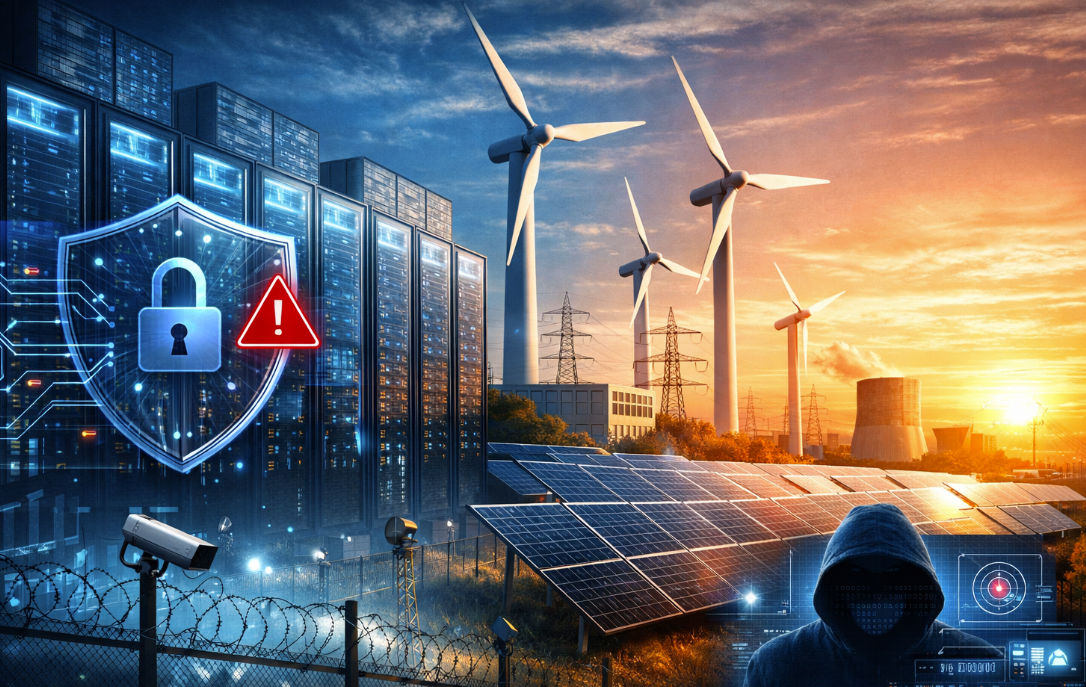
Co-located clean energy and data center campuses introduce a new threat model: cyber-physical convergence risk. Solar farms, wind installations, battery storage systems, and grid interconnections are increasingly software-defined, remotely managed, and interconnected with operational technology (OT).
This expands the attack surface significantly. A failure or compromise in energy control systems could directly impact compute availability. Conversely, a data center breach could expose sensitive operational data about power generation assets.
CISOs must therefore evolve beyond traditional IT security boundaries and collaborate closely with OT security, physical security, and resilience planning teams. The future security architecture must assume zero trust across both digital and energy layers.
Reduced Grid Load, Reduced Systemic Risk
One of the most underappreciated benefits of the co-location model is systemic risk reduction. By bringing new generation capacity online alongside new load, these projects avoid draining existing grid resources, improving stability for surrounding communities and industries.
This matters for security leaders because grid instability amplifies business risk. Rolling blackouts, emergency load shedding, and regulatory intervention all increase the likelihood of force majeure events that bypass traditional risk controls.
In effect, purpose-built power for data centers is not just an efficiency gain: it is a defensive control against macro-level infrastructure risk.
A Blueprint CISOs Should Act On
This model will not remain confined to the United States. As AI regulation tightens and energy sovereignty becomes a geopolitical priority, similar architectures will emerge globally. CISOs who understand this shift early will be better positioned to:
- Influence data center siting decisions
- Embed security requirements into energy partnerships
- Align cyber risk management with sustainability and ESG strategies
- Anticipate regulatory scrutiny around AI infrastructure resilience
The convergence of digitization and decarbonization is not a marketing slogan. It is a structural transformation of how critical systems are built and defended.
For CISOs, the message is clear: energy strategy is now security strategy.